Observations, 24th March 2025

To the swimming pool at a later time than usual, delightfully quiet. Halfway through my regular 25 minutes, dreaming as I swim, I notice grandmother and small child entering pool. Then treated to an excellent lesson on how to tempt a little child into the water. Grandmother, from steps into the pool, throws small floaty thing in and encourages grandson to come and retrieve it. This, the child happily does, entering into the game. Each time the object is thrown in a little further, the grandmother and grandson having a lot of fun. On my way out of the pool, I congratulate them both on having such a happy time. I asked the child what his name was. He told me, “Henry”. “Like the king”, I say. “Yes”, says grandma, “he recently received a postcard from his uncle addressed to ‘King Henry’!”

“Oh,” I replied, “our son is called Hal, like Prince Hal in Shakespeare’s Henry the 4th.” I then introduced myself to Henry and told him my name was Penny. As I made my way to the changing room, I called back, “Goodbye, Henry.” He replied, “Goodbye, Penny.”

We were on our way then to rendezvous with our son Tristan and his wife Laura to celebrate Mother’s Day early, as they are away on appointed day. We meet at the Mizu restaurant at the Lodore Hotel in Borrowdale. A regular haunt of ours, though we hadn’t been for some time. Excellent food as ever and a good crack over the lunch. And a fabulous bag of Mother’s Day gifts from Tristan and Laura. As we left, we encountered some wedding guests enjoying the sunshine and some fizz. Sitting on a wall were several women chatting. One of them was wearing some amazing shoes, high heels with plaited yellow and pink leather, which I felt compelled to admire. Opposite them, standing by the opposing wall, were a group of men. One of them said, “She’s very punchy, isn’t she? ” I was perplexed. One of his companions said, “She doesn’t understand what you’ve just said.”

“What does it mean?” I say.

“It means she’s lucky to be married to me!”

“By the same token, you’re lucky to be married to her, too.”

I didn’t think my answer went down too well with him, so I responded quickly, trying to be diplomatic, “Surely you are both lucky to be married to each other.”

Moving on, going back to the car, we behold the bride, beautiful in shining white, flowing dress, aflame in the sunshine, on her way towards the rest of the guests. The wedding ceremony had just finished in the gazebo, and she had a tail of other guests behind her. She was talking and laughing animatedly to one of her companions. I stopped her and said how beautiful she looked and that my husband, Bob and I, had spent the first night of our honeymoon in the same hotel some 59 years ago. I pointed towards Bob, who was ahead of me with our son. The bride immediately replied, “What is the secret?”

“Don’t argue,” I said. “It takes two to argue. If one of you refuses to argue, the argument will not continue.”

“That’s wonderful,” she said, then kissed me and said, “Thank you.”

A good day, so far!

The Girl from Ghouta

The Girl From GhoutaThe Face That Launched….

We were very moved by the television images from the gas attack on Ghouta, Syria.

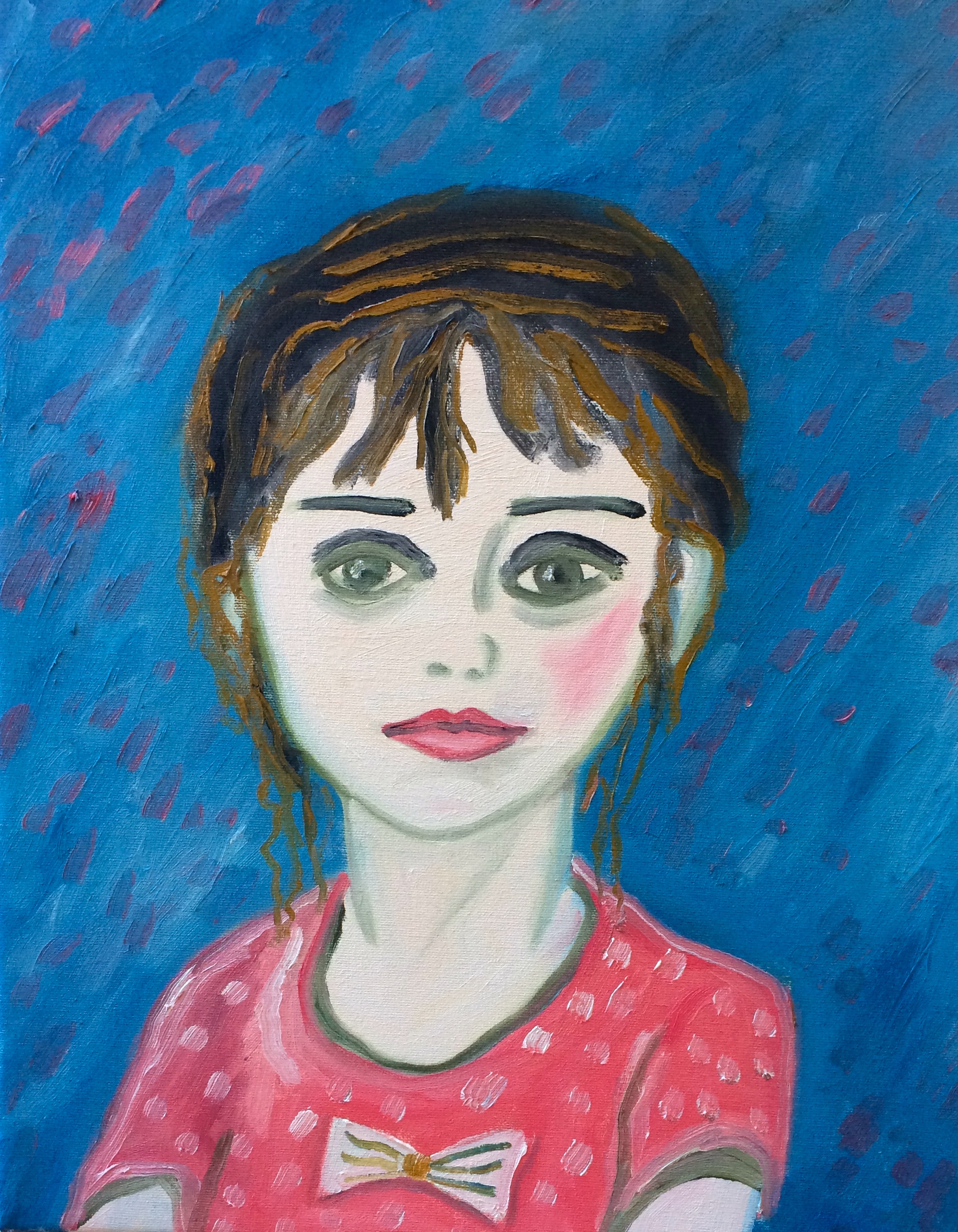
In particular we were struck by the face of the young girl that the camera caught gasping for breath along with others. She survived the attack and later we learned her name was Masa.

Her portrait demanded to be painted. She has a spirit that has not been destroyed.

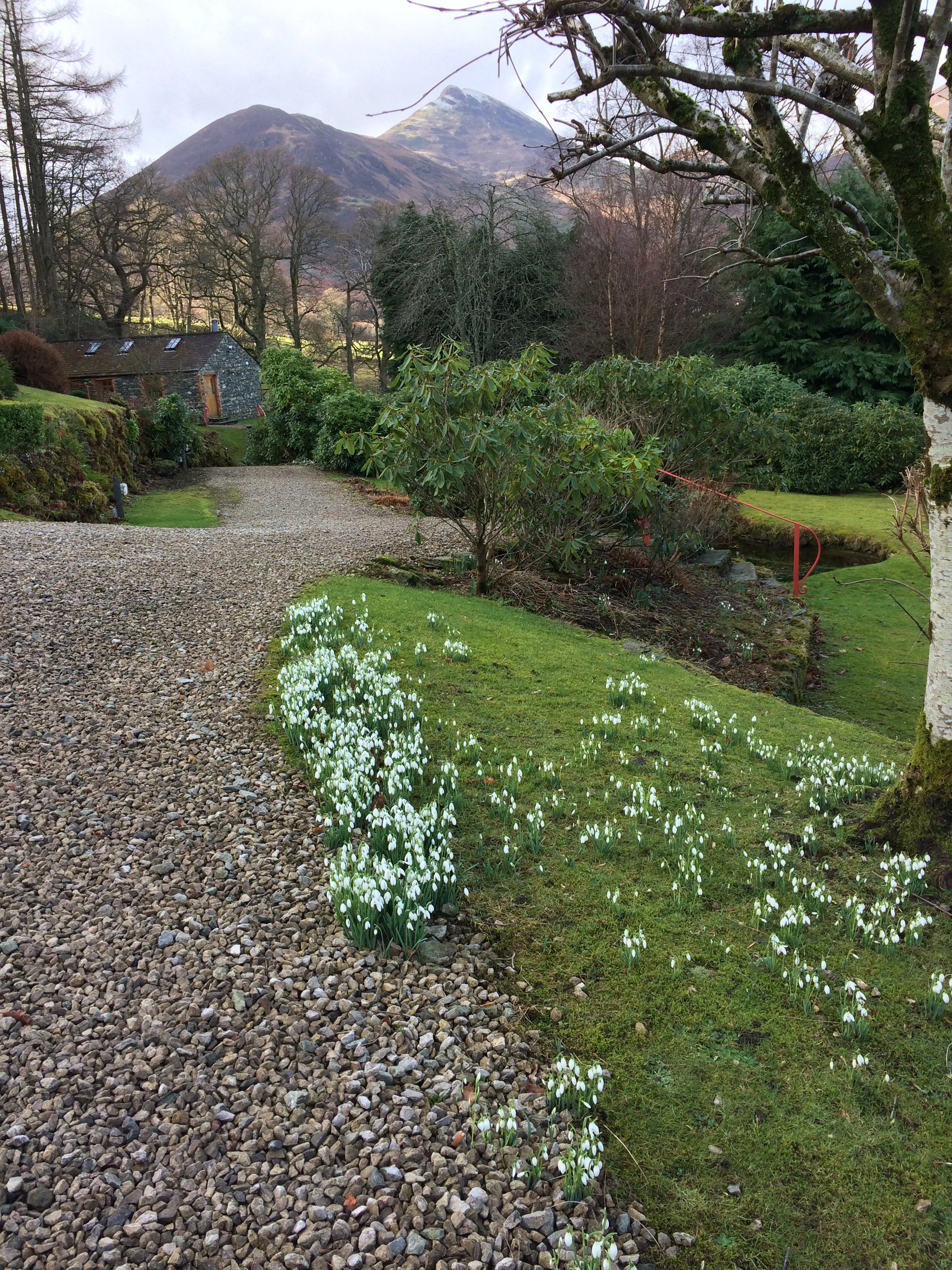
I Bring You Snowdrops

Honours are for those
Who hold out
Against the odds.

The blossoms dazzle
Before falling
In the breeze.

The fruit shines
Until conquered
By over-ripeness.

Leaves glow gold
Despite the certain
Return to earth.

The final battle
When it comes
We must lose.

Until it comes
We must dazzle
Shine,glow gold.

So
I bring you
Snowdrops.

They have fought
The loss of Spring
Summer and Autumn.

Now, minutely elegant,
Valiantly they lead
Against the inevitable winter.

So I bring you snowdrops
For honours, for holding out
Against the desperate odds.

And I bring you love.

Bob Fowler

img_3489

Snowdrops and Causey Pike

From Aleppo to Theatre by the Lake

We were at the Theatre by the Lake. We had been meeting the technician Karl to sort out final arrangements for my exhibition there. We were also due to pick up in Keswick the remaining works that had been framed and additional prints for the show. The printers said if we called after one o’clock the prints would be ready for collection. We decided to visit the cafe and have a drink so the timings would work out. Bob found a table and I took my place in the queue to collect some refreshments.

As I waited someone from the box office came to speak with me. She said there was a Mr Rigby who wanted to meet me and would it be okay for her to send him in to say hello. I said that would be fine and that I knew Phil Rigby from a recent photo shoot for Cumbria Life. Imagine my surprise when a man found me in the queue and asked me, “Am I speaking to Lord Ullin’s daughter?”

It took a little time for me to realise the connection. This was TONY Rigby – someone I had been at college with some 50 years previously and had not seen since. He was researching previous students from Bretton and had come across my website. He and his wife had decided that day to try and find me. He had a photo of me looking outside the door of my Studio on Catbells – and had read I was about to have an exhibition at Theatre by the Lake so had decided that was the best place to start a search for me. It was a lucky happenstance that Bob and I were indeed at the Theatre at that moment.

We went on to have a very lively and animated discussion with all kinds of revelations. Tony reminisced about the first time he had gone to an English lecture which Bob used to give to the whole year group. Bob had begun by reading directly from Iris Murdoch’s book Flight from the Enchanter. This baptism had given Tony a lifelong love of reading! He also told me that Bob was the most charismatic and popular tutor.
I asked Tony how he had met Linda (who was an American). The story that unravelled was remarkable. Linda recounted the tale: she had been in the Souq in Aleppo and needed to borrow $100. She spotted Tony and thought he looked as though he might be English. She went up to him and asked him if he could lend her $100. This he did. And that was the beginning of their relationship!
We invited them to join us at home for tea later that afternoon. There was so much more to be shared! Tony and Linda arrived with goodies and a laptop. They showed us some fascinating archive photographs from Bretton Hall – the former seat of the Allendale family before it became a College. Tony, researching past history of place and people had made some intriguing discoveries. He had managed to make a film from still photos of an early student production of Purcell’s Dido and Aeneas set in the Bretton gardens below the terrace.
It was time to take Linda and Tony down to the Studio to show them some of my paintings stacked around ready to go to the Theatre. Linda wanted particularly to see Boy from Aleppo. We had discussed the picture of Omran back at the Theatre ( I had told them that the only thing I felt I could do was to paint Omran, whose image seemed to sum up movingly the Syrian conflict.) Linda loved the painting. Later, when we were on our own, she whispered “Consider the painting sold, but don’t tell Tony yet”…. I confirmed she could buy the painting – but not have it until the exhibition came down.
Thus October 14th had turned into a remarkable day for Bob and me! The strange thing was that earlier that day over breakfast Bob and I had been talking about days that turn out to be special. We had remarked that the auguries were good – that the 14th was Rose’s birthday (Rose Wylie – a very dear painter friend), the sky was blue, it was the first preview night of The Pacifist’s Guide to the War on Cancer at The National in which Hal (our son) was performing. Little did we know that Aleppo, the Theatre and Bretton Hall (where Bob and I had met) encountering Linda and Tony, all would combine to make a day to remember and record.
On the mystery of Lord Ullin’s daughter: Bob and I married in Borrowdale Church and after the wedding breakfast sailed away across Lake Derwentwater into the setting sun. The wedding guests had followed us down from the reception to the lake. As we were carried away by motor-boat we heard the Principal of Bretton, gesticulating at the end of the Lodore landing stage, declaiming “Come back Lord Ullin’s daughter”.* Tony Rigby had read about this on my web site – hence ‘Are you Lord Ullin’s daughter?’ – fifty years since we had last met
*Lord Ullin’s Daughter : A poem by Thomas Campbell which has the line ‘Oh! I’m the chief of Ulva’s isle. And this is Lord Ullin’s daughter…Boatman do not tarry! And I’ll give thee a silver pound, To row us o’er the ferry’.

1

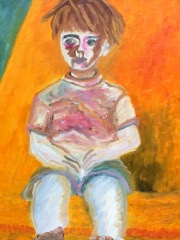
Boy from Aleppo

The Model and the Cheshire Cat

The Model and the Cheshire Cat by Penny Fowler

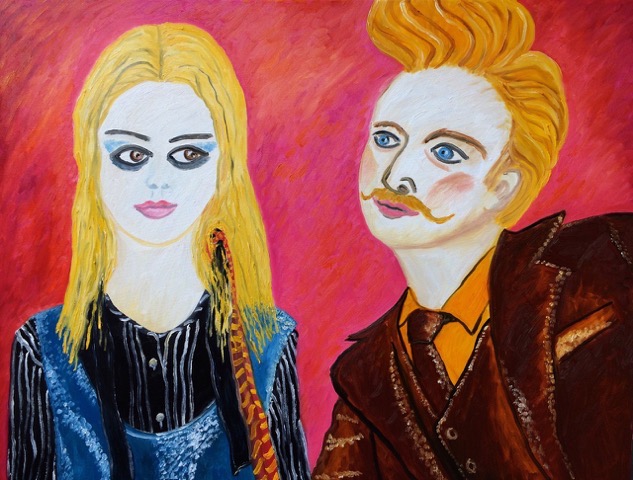
Kendall Jenner and Hal Fowler

STOP PRESS! Penny’s next one person show is at The Friends’ Gallery, Theatre by The Lake, Keswick: October 25th – November 22nd, 2016.

The title of the show is ‘The Model and The Cheshire Cat’.

My work is about reality, what I see, what I feel, what touches me, what catches my eye. Sometimes that can be about big events in the real world, or a face in a crowd, a mountain, cherries in a bowl, a bunch of flowers, actors in a show who are already several times removed from reality. Reality is not the same as realism. My work is not about imitation but rather a response to objects, things, my space in the world through painting and drawing. A painting is after all a painting. I do not feel I should explain my work – it should speak for itself. Art has no need of theory. I know what I am going to paint or say, but once I get started I work vigorously and the work has a life of its own. Decisions about colour or how to do something happen intuitively on the way. Sometimes, going back to the studio after I have finished a painting I find myself thinking ‘Did I do that?’

See more of Penny’s oil paintingswater colours, and digital  works at  www.pennyfowler.com

QUI NOUS SOMMES : WHO WE ARE

Last blog we talked about ‘Who are you?’   We were then in the fairytale context of wonder.land and the question ‘Who are you?’ was the challenging line of the Caterpillar’s song.

This blog arises not from a Wonderland but from the very real world of today – the Paris terrorist attacks. The French President, Francoise Hollande, used the assertive phrase, Who We Are – Qui Nous Sommes, in his rallying response to what he called an Act of War.

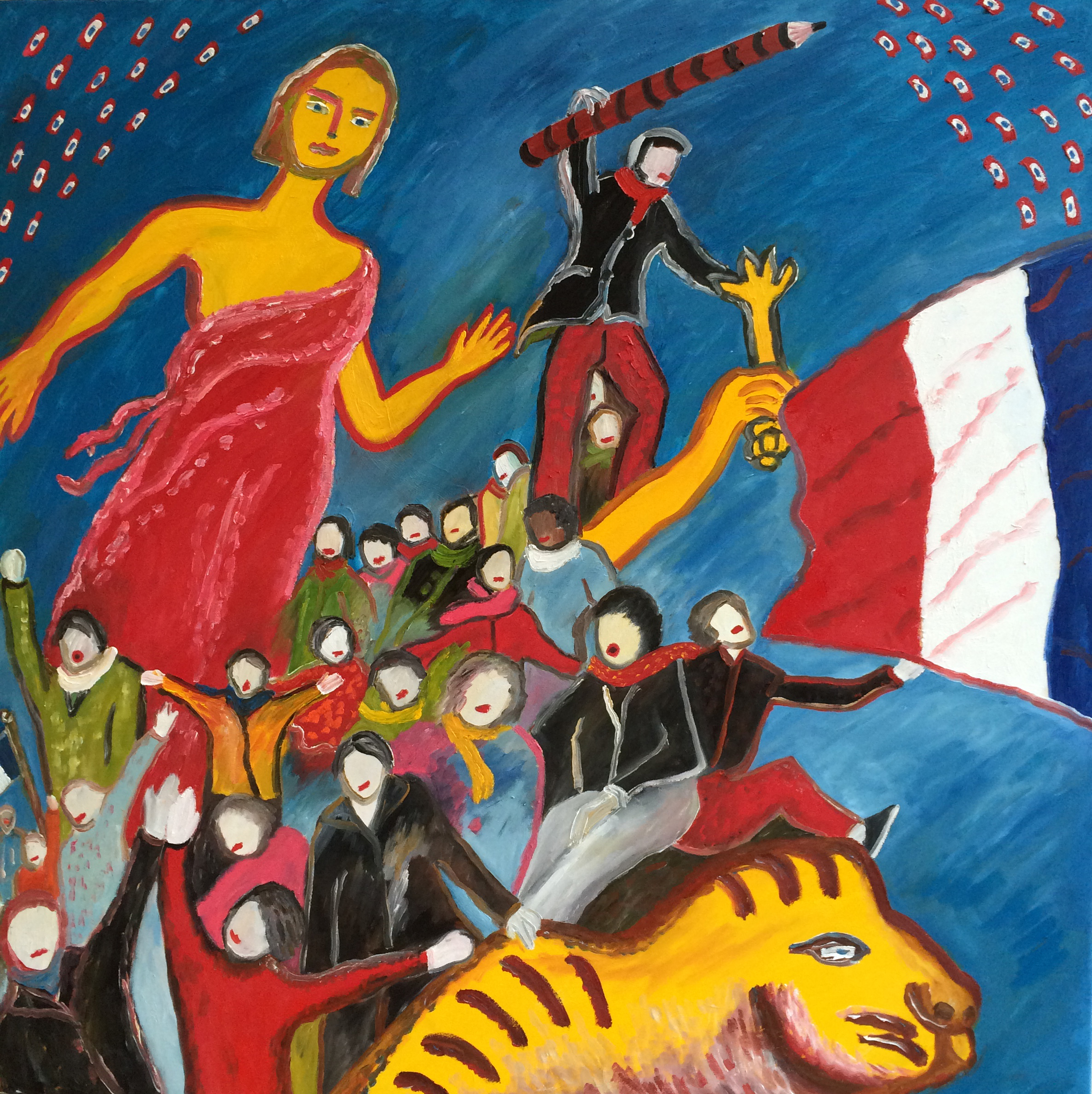
This is not a political blog. It is a sharing of what seemed to us a remarkable but chilling coincidence. At the same time as we were hearing President Hollande on Television News, Penny was preparing a work, painted earlier in the year, for submission to an exhibition. The original title was Nous Sommes…

The title now had to be Qui Nous Sommes. Here it is:

Qui Nous Sommes

Penny Fowler

Oil on Canvas  36″ x 36″

WHO ARE YOU?

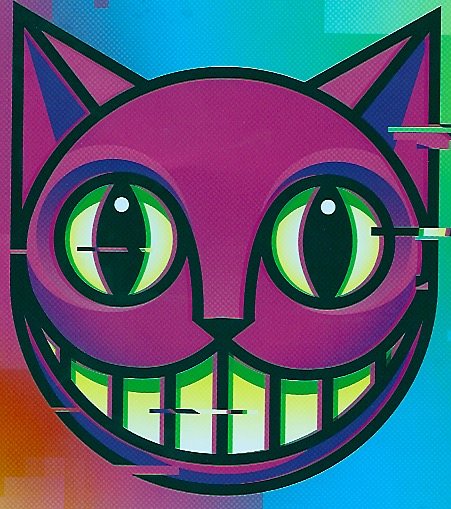
The Cheshire Cat from                   wonder.land  ..........

The Cheshire Cat from
wonder.land ……….

Well, it would be fair for you to turn the question on us: who are you? Of course, you know the short answer to that : we are ‘Penny and Bob’. They are our so-called Christian names. But the question pushes us into a hole (like the one Alice fell into?). Who are we? What are we? Where do we come from? Where do we go? Do we like who we are? Would we rather be someone else? (Taller, smaller, fatter, thinner, happier, brighter, sharper, sexier)? Would it be possible to be someone else? How might that be possible? Well, actors ‘play’ that all the time, don’t they? When we are thinking about these issues, how do our thoughts work? Are they just electric currents which translate in our ‘minds’ into words? How do we debate these questions within ourselves, within our minds? Do we debate them with words? Where do our thoughts come from? If there are voices, are they all inside us? Or do some come from outside? What tells us to stand up, or sit down. or to laugh or to cry? What tells us to tread carefully on the edge of the cliff? When someone jumps, who or what tells them to leap into the unknown? Why don’t we all leap off the cliff? Because we are ‘wise’, ‘balanced’, sane?’ Are our answers today the same as they might be tomorrow? There are others, perhaps you, perhaps your partner, your friends, your  children or your friends’ children who do not think like you/us. Some say they hear voices. Some of them are ‘bad voices’, which  encourage self harm. Those young who discover and take take drugs have their thinking and actions confused. Some characters choose to escape into another world, change their personae, explore another country, especially in fiction through a wardrobe door or hole in the ground. Sometimes we do not choose to enter a hole in the ground. In Lewis Carroll’s story of Alice in Wonderland, Alice chooses to follow a White Rabbit down a hole into a fantastic world where she meets a host of creatures and ‘human’ characters. She has an encounter with a caterpillar sitting on a mushroom which has magical properties, a pigeon who thinks Alice is a thieving serpent, she meets a Duchess, a grinning Cheshire cat, a cook. The Cheshire cat directs Alice to the March Hare’s house, where the Mad Hatter and the Dormouse are having tea together – trapped in perpetual ‘tea-time’. Alice escapes through a door in a tree. She meets the angry Queen of Hearts and the King of Hearts who tries to arrange for the Cheshire Cat’s execution. But since by this time the Cheshire Cat in Wonderland is only a head floating in mid-air no-one can agree on how to behead it. The Queen orders that Alice be beheaded. But Alice suddenly grows HUGE and knocks over the Queen’s army of playing cards. Alice wakes up and finds herself on a river bank from where she began her adventure. What has this Alice invented by Lewis Carroll got to do with anything? Well, as Rufus Norris, the Director of  the new musical wonder.land comments: ‘There are some big, big questions, about identity and self-determination, which are absolutely at the core of the original story.’ Moira Buffini. who wrote the script of the new musical wonder.land says, ‘it’s the relationship between the real world and wonder.land that makes the story work. It’s the words of the Caterpillar: “Who are you?”. That’s become the central question of the piece.’

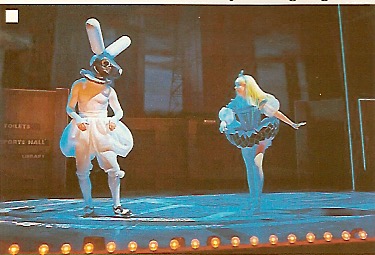
Aly’s Avatar/Alter Ego and the White Rabbit wonder.land Palace Theatre Manchester

Rufus Norris suggests that until the internet opened up many children felt like ‘they weren’t what they should have been. In terms of inclusivity and social confidence, (the internet) has totally transformed the landscape.’ Robert Douglas-Fairhurst, exploring the ‘origins and afterlife of Alice’ writes, ‘Wonderland has developed into something much bigger than the fantasy of one imaginary little girl. Instead, it has become a way of thinking about all the other worlds into which we might want to escape when real life seems too much for us, or perhaps not enough to satisfy us.’ So the question ‘Who are you?’ turns into ‘Who in the world am I?’   ‘Ah, that’s the great puzzle!’  thought Alice. And now ‘off line’ is boring. As Aleks Krotoski has written, ‘To achieve a basic level of stimulation, we need technological enhancement. Games, blogs, Tumblr, Instagram, WhatApp, Streaming, sex, Snapchat. Elsewhere is so much more exciting than here.’ And so Aly in wonder.land finds it.

The Game Penny Fowler

The Game Penny Fowler i Pad print

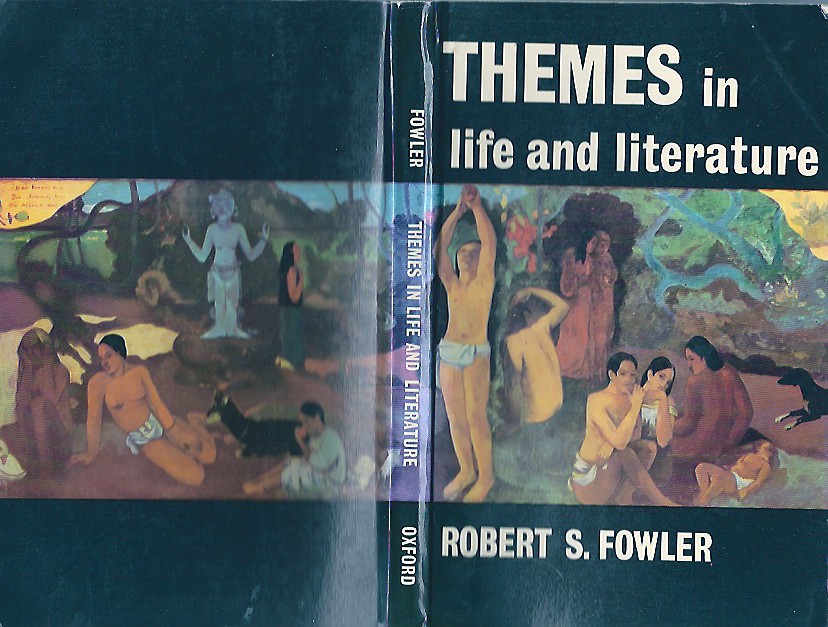
The Independent’s critic summarises the show’s premiss: ‘Wonder.land is a place where everyone ‘can be exactly who you want to be”. The show’s heroine Aly – a ‘mixed race miserable teenager whose parents have separated’…creates an Alice avatar in which Aly is whiter, thinner, blonder and more glamorous than in real life. The interaction between Aly and Alice promises intriguing interplay between aspiration and actuality.’ Aly does not fall down a hole or go through a wardrobe door to find her alter ego. She invents it by the simple device of finding a computer game,wonder.land, which she enters through the screen of her mobile phone. Perhaps one of the most spectacular, inventive and astonishing accomplishments of the production is to see what Aly sees on her mobile reproduced technicolour on full stage screen – then, lo and behold! the caricatures of Aly’s dreams step on to the stage as flesh and blood characters.  They are ‘human’ and ‘animal’ – ‘stunningly costumed’. Included are the giant caterpillar, made up of four actors, with the leading actor in the head singing the captivating and demanding song,  WHO ARE YOU? which summarises what all the action is about. It is comic, beguiling, surreal, threatening, always challenging. Cyber Space becomes ‘a contemporary equivalent’ of Lewis Carroll’s wobbly Wonderland.The Rabbit hole down which Alice falls is available to every contemporary teenager – for the present via the internet. Whether or not there can be a happy ending very much depends on how well Aly, Alice or any of us can distinguish the real world from the psychedelic, and confront it. These questions are not only worried at by teenagers and adults now.  Matthew Arnold in 1855 in his poem, The Grand Chartreuse, asks, as he surveys the Carthusian monastery: ‘And what am I, that I am here?’ Is the monastery another world of escape/discovery? The late Sir Herbert Read, author of On Beauty, in his Foreword to Themes in Life and Literature ( R.S.Fowler  Oxford University Press 1967) writes of the dangers of confusing ‘escape’ – with ‘distraction’. (Falling down the rabbit hole?) He warns that when we wake up, if  we have merely indulged in distraction, we experience a ‘hang-over’, a painful emptiness – ‘no melody to the ear, no understanding of the World. We have been ‘on a mental binge and wake to a sense of desolation and disillusion.’ It is up to each of us to decide what kind of experience we receive from the Musical wonder.land.  For many, we believe, it can bring a greater understanding of the world we and our children currently inhabit. There are certainly melodies to the ear, recollections of wonder and conciliation and a comforting promise of Happy Ever After.

Scan

Where do we come from? What are we? Where are we going? Paul Gauguin 1897 Cover of Themes OUP 1967

********************************************************************************* The new Musical wonder.land premiered at the Palace Theatre 2nd July 2015  – A Manchester International Festival/National Theatre co-production. Director:  Rufus Norris   Book & Lyrics:  Moira Buffini Music:  Damon Albarn  Set Designer: Rae Smith CAST Sam Archer-Dum, Lois Chimimba- Aly, Rob Compton- The White Rabbit, Rosali Craig- Alice, Ivan De Freitas-  The Dodo, Luke Fetherston- The Lizard, Hal Fowler- The Cheshire Cat & The Caterpillar, Anna Francolini – Ms Manxone, Lorraine Graham- Ensemble, Paul Hilton- Matt, Karina Hind- Kitty, Holly James- The Hedgehog, Sam Mackay-Dee, Daisy Maywood –  Mary Ann, Enyi Okoronkwo- Luke,David Page-The Mouse, Golda Rosheuvel- Bianca, Cydney Uffindell-Phillips- The Mock Turtle, Witney White- Dinah. wonder.land opens at The National Theatre 27 November 2015. wonder.land opens at the Theatre du Chatelet, Paris,  in 2016. wonder.land was commissioned by Manchester International Festival, National Theatre and the Theatre du Chatelet.

My Father was NOT the Chief Inspector of Holes

The late Poet Laureate, Ted Hughes, in Meet My Folks gave the title

My Father’s the Chief Inspector of Holes

to one of his poems.

I was friendly with Ted especially through the early days of the Arvon Foundation. Indeed, he offered me what I regarded as a generous and complimentary  critique  of one of my short verses penned during our first experience of Sheffield as residents. It was 1979, the year when even the grave diggers went on strike and it was a savage winter. I summarised my feeling about Sheffield briefly:

Spring

Struggles

To come

To Sheffield.

“A masterpiece of brevity and observation. I wish I had written it!”   Thanks, Ted….But I should have asked you if your father really was the Chief Inspector of Holes.

While we are talking about Inspectors I might as well confess that my elder brother, Bill, my cousin Vic and yours truly were (for a while) all HM Inspectors. Yes, a Fowler/Farthing mafia in  the Department (Ministry) of Education. My mother, Breta, used wickedly to boast to her friends in the Mothers’ Union where she was the enrolling Member (earned you an invitation to a Royal Garden Party)…used to boast that both her sons and nephew were in ‘The Ministry’. I do not know what Breta would have told them if we all had been Inspectors of Holes.
Scan 3

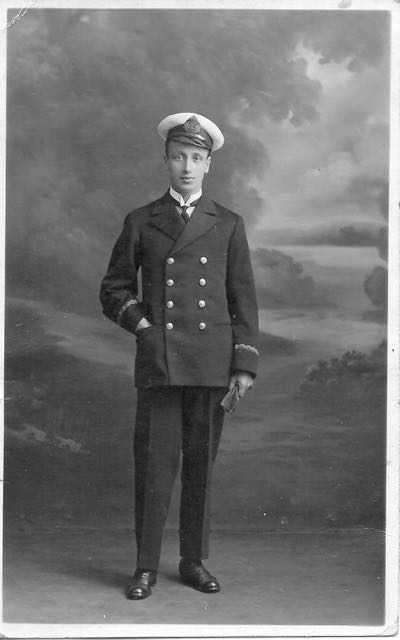
Marconi Radio Officer William Fowler

 I want to tell you a little about my father, Willie or Billy as he was variously called. He was not an Inspector of any kind. My earliest happy memories of him as ‘dad’ are when in the evening I would sit on his knee and he would tell me stories. He was a good story teller. I remember best his telling of the exciting adventures of Dick Turpin and his good horse, Bess. Then of course there were Robin Hood and Will Scarlet. Invariably there was a character he dubbed ‘the Little Old Lady’. She was always a mysterious force for good and later reflection led me to believe that the Little Old Lady was probably based on Old Mother Shipton and Mrs Shipton’s cave – you can still visit her ‘home’ in Yorkshire. However the very best story for me was dad’s hair rising adventures at sea.

MY dad lived his youth during the days when tuberculosis (TB) was not uncommon. His much beloved elder brother, John, died young of TB.  Billy decided that the safest profession was at sea where hopefully there would be less chance of catching TB. The loss of the Titanic had stimulated debate about the necessity to have qualified radio operators on all licensed ships. Marconi was the brand name in the market. If you qualified as a radio operator with Marconi, you were entitled to wear the Marconi designed embroidered M on your cap – a great treasure. So, Billy took himself off to London to train as a Marconi operator and on 19 November 1913  he was awarded a certificate of Proficiency in Radiotelegraphy by the Postmaster General which authorised him to ‘operate as a first class operator on board a British ship’. He was just 21 – and the Great War was looming. Billy was formally appointed to the Staff of Marconi on 8 February 1914 at a salary of £1 per week. (That would normally be implemented by the owners of whichever ship he served on.) His first Marconi increase in salary was on 7 February 1915 – a rise of two shillings and sixpence. (All these details are recorded in the Marconi Records now stored in the Bodleian Library, Oxford.)

Scan 4

So Billy began his life at sea. One of the sea stories I asked for over and over again was how dad got the better of a Captain Kelly.   Captain Kelly, a big, bullying man, I understood, was in the habit of calling my dad ‘Sparks’.  Dad did not care for that  – he was proud of being a Marconi Radio Operator – and often he was the only Operator on the ships he sailed in. (It had become compulsory for all sea-going ships to have a qualified radio operator on board, even if it was only one, and the 1914 war with Germany had just begun, making radio Officers essential in the case of distress.) Anyway, Kelly called my dad Sparks.  Dad requested Captain Kelly NOT to refer to him as ‘Sparks’ but by his proper name and rank. I loved this story, when my dad imitated Kelly’s response –  waving his fists in the air and demanding, “And what will you do, Sparks, if I don’t, heh?! What will young Sparks do?”  My dad, cool as  cucumber, as they say, replied, “Captain, I will call YOU,  KELLY!

 I imagined the scene – the big, red haired, blustering Kelly, and my not very tall dad, standing up to him and ‘cheeking him’. I used to hold my breath waiting to hear Captain Kelly’s reaction.  (Did they still put sailors in irons, or make them walk the plank, or order them 50 lashes? I do not think those options were open to Kelly.) Kelly retorted  ” Want to be clever with me, do you Sparks? Very well, I am stopping your wages immediately. You will not receive any pay!” And with that, Kelly marched off.

“And what did you do then dad?”  (I knew very well because I asked for and heard the story many times). ‘”Well, Bobbie (I was sometimes Bobbie, sometimes Bob), I went to my radio cabin and sent a morse code message to Marconi in London, telling them that Kelly, the Captain, was witholding my pay.

 “Then what happened?” (I knew very well but wanted to hear it again).

“Well Bobby, then I got a message back from Marconi in London to take to  Captain Kelly.”

“What did you have to tell him?”

“Captain Kelly, I have a message for you from Marconi: In view of the fact that you are withholding my pay Marconi are withdrawing my services from the ship. You are to proceed to the nearest port where Marconi Radio Officer Fowler will disembark.” I loved it. “What did Kelly do dad, what did he do?”

“What could he do, Bobbie? If I left the ship he couldn’t sail without a radio operator. He HAD to pay me!  End of story!”    How I loved my clever and brave dad standing up to and winning against Kelly!

The most exciting to me of my dad’s stories was the hair raising drama of a real war encounter. He was sailing in an unarmed merchant ship when he received  a morse message for the Captain, “Proceed to Gibraltar to have a Cannon fitted”. They sailed into Gibralter, the cannon was fitted, they returned to sea, now armed, into the Bay of Biscay. ‘All hands on deck!’ The look out had spotted a German U boat on the surface. The gun crew hastily fitted a shell into the new cannon, and fired. The U boat was still there. Crew went to load a second shell. No luck!  Help! The breech was jammed. Feverish work on the cannon.The submarine approached nearer.

It was time for Billy to be tested. Only he could get a message out calling for help.  He started tapping the morse key. NO SIGNAL!  Billy suddenly remembered that the Scottish captain liked to preserve the ship’s energy supplies and had the habit of running at less than full power – hence inadequate electricity supply for the radio cabin.The u boat was approaching.  Billy raced to find the captain and demanded an immediate return to full power. Electricity restored to his apparatus Billy was just finishing an SOS call (… —…) when a worker from the engine room snatching some fresh air on deck ran to Billy’s cabin and shouted in, “Master, Master! Torpedo he come!”

The torpedo exploded amidships. The U boat approached and megaphoned the crew to swim to the U boat. (The known practice was for the U boats to submerge when any rescued ‘enemies’ were on the U boat deck). At that moment, from over the horizon, a British destroyer appeared, moving at full speed and firing all its guns. BANG! BANG! BANG!  Dad’s SOS had been received. The sub swiftly submerged. The crew of the ship made into the lifeboats. The last they saw of the ship was the mast disappearing below the waves with the mascot monkey clinging to the top. Then awesome silence and emptiness save for the vision of the approaching destroyer. It reached the life boats. Another loud hailer: “We can only stop for 5 minutes. Swim for it.” Billy was amongst those picked up – without his hat or 21st gold watch – but with the valuable platinum which he had the calm to remove from his equipment and store in his waxed tobacco pouch – the true Yorkshireman.

 The destroyer had only just started its patrol so the rescued men had to sleep anywhere they could find until the patrol was completed. My father claimed that he had slept with his head on the ammunition pile.

Safe on land Billy returned to Liverpool where his parents were then living – his mother, Emma, bed ridden and a sick woman. In the story the first thing Grandma Fowler asks her boy, Billy (she was not told of the sinking) was, perceptively – “Willie! Where is your hat? If that Kaiser Bill has harmed a hair of your head I’ll be out of this bed and deal with him….”

No wonder my dad was able to stand up to Captain Kelly!
Scan 6

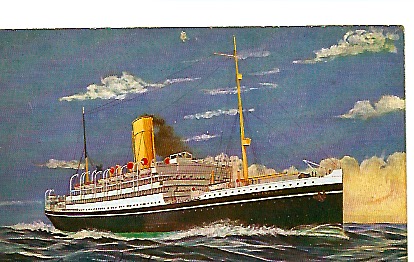
The S/S MARLOCH – one of the ships Billy sailed on.

 (* Readers interested in current radio activities and practice : Go to one of the data bases for radio enthusiasts – e.g. QRZCQ.

The Radio Officers’Association (ROA) has a wealth of information about meetings and Records.

The Bodleian Library Oxford now holds the majority of existing Marconi records, including the details of each Marconi Radio Officer, date of employment, salaries, date of leaving the service or ‘Failed to return from War Service’. )

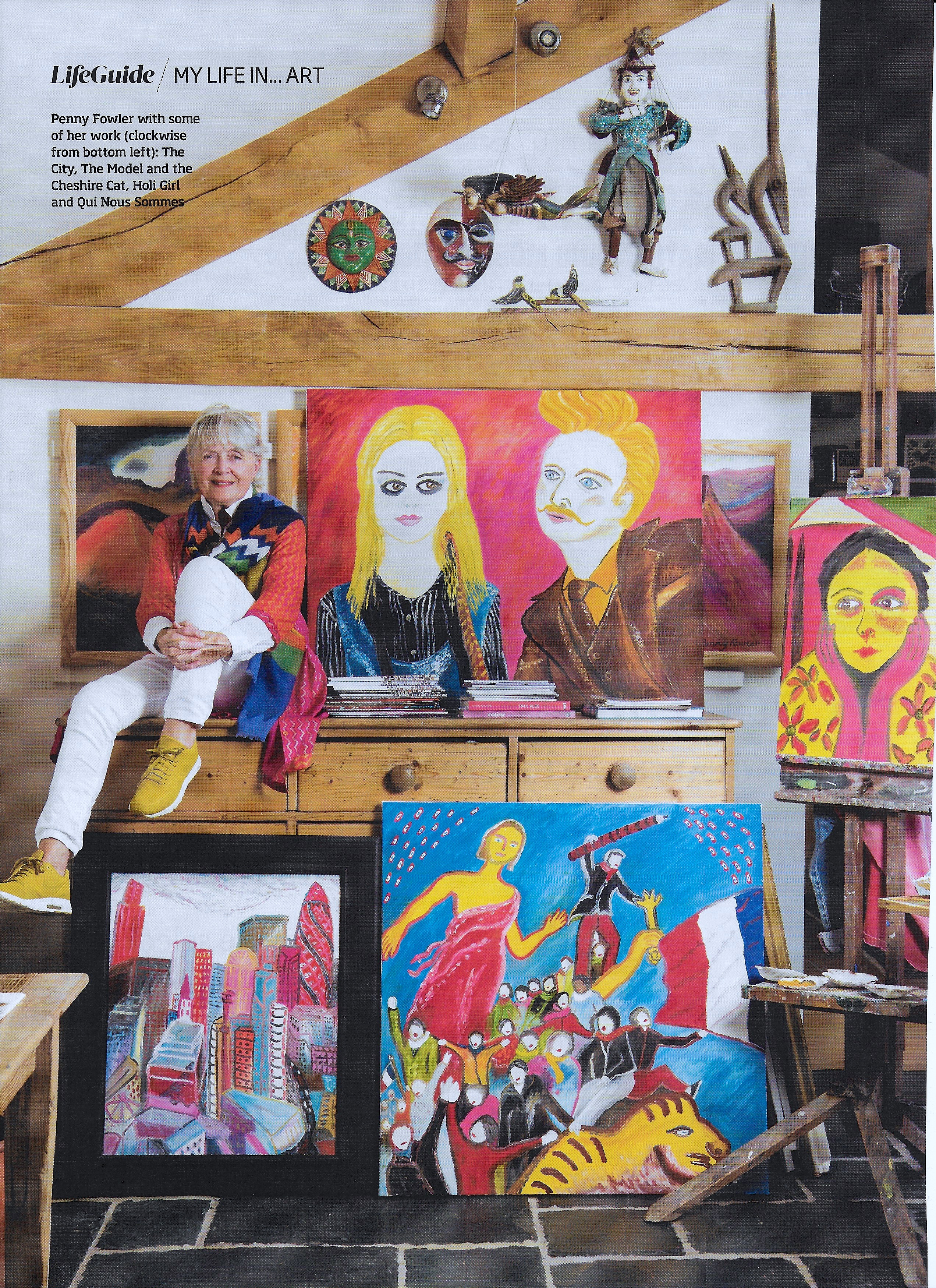
The Studio on Catbells 

Repas (detail)

Repas (detail)

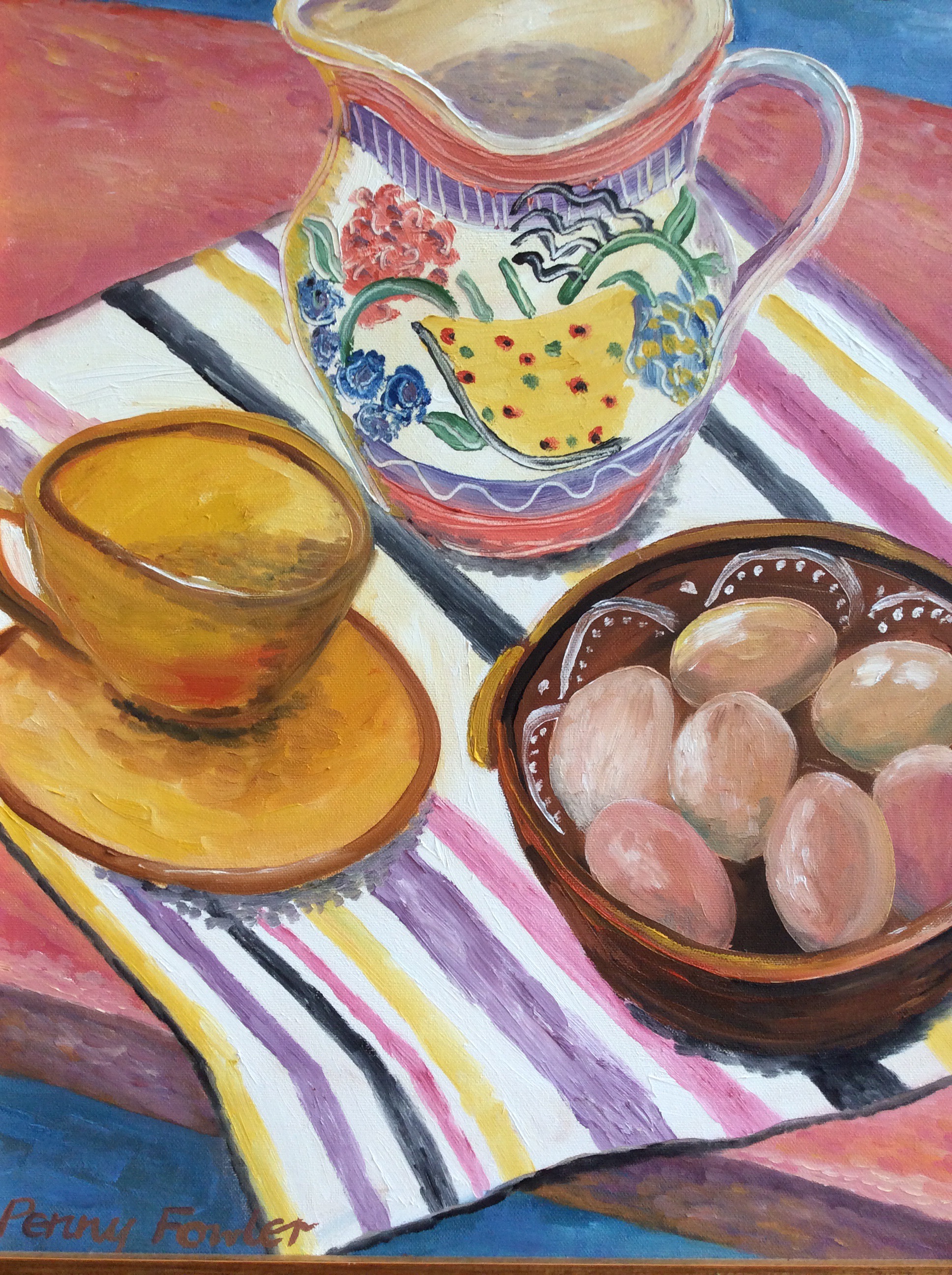
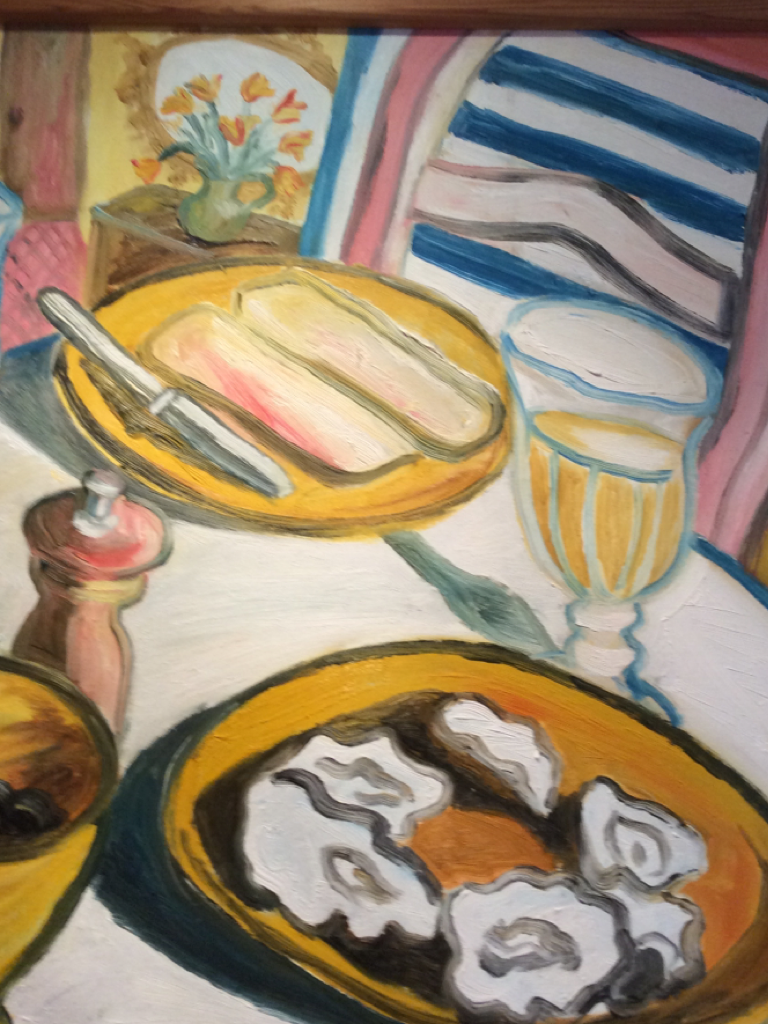
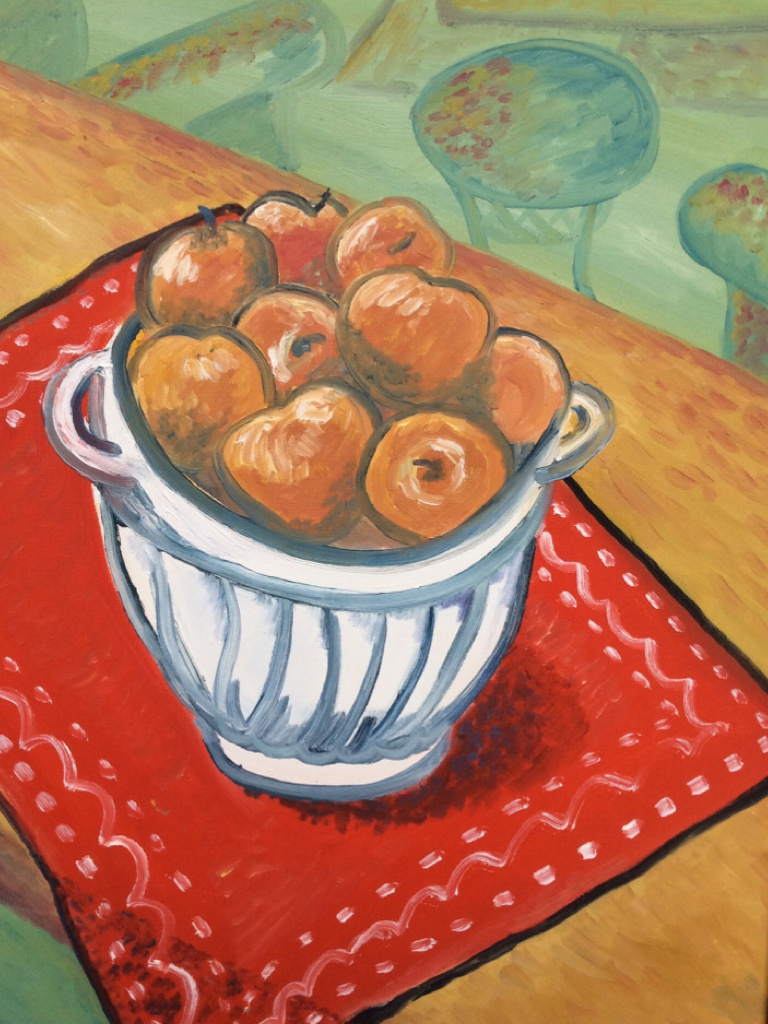
As I walk down to the Studio this morning I am struck again by the beauty of this place – Causey Pike in front of me framing the Studio, the mass of Skiddaw behind. The ducks are diving in the pond, the cock pheasant struts and flutters, the cuckoo echoes through the valley, a red squirrel leaps past me. Opening the Studio door I am greeted by the smell of oil paint, the colours, the collections of objets trouves, yellow pottery from Vallauris, an old rug from Morocco and walls of paintings. I muse at the number of works celebrating the table, food and drink.  Surprise surprise! We rather like food.

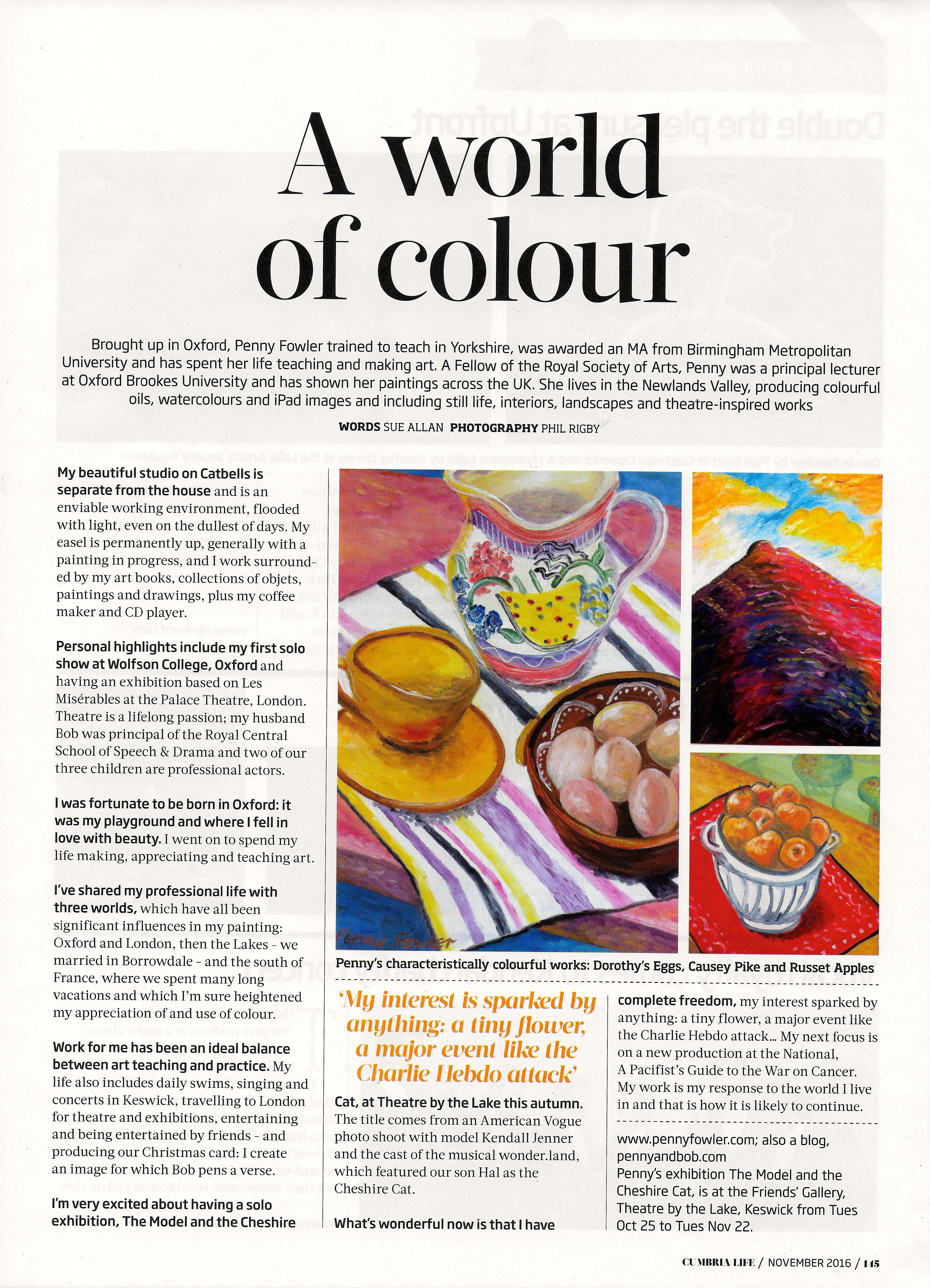
Dorothy’s Eggs (detail)

774

Oysters and Olives (detail)

759

Russet Apples (detail)

Bob ‘scribbles’ (writes), not paints. He also dreams:

Jolly Waking Jingle

Last night I was a Stilton

Tonight I’ll be a Brie

Her arms wrapped around me

Sleeping happily.

I was in a pile of people

Somewhere half way up

The tea bell sounded loudly

And rudely woke me up.

(Bormes-les-Mimosas 6 February 1989)